


A survey reveals healthcare executives have contrasting outlooks on their organizations versus the overall industry for 2026.
Quiver AI Summary
A recent survey by B.E. Smith reveals that while nearly 75% of healthcare executives feel optimistic about the future of their own organizations, over half anticipate a more challenging year for the healthcare industry overall. This report highlights a growing confidence gap and an increased demand for leaders adept in artificial intelligence (AI) technologies, amidst ongoing issues with succession planning and clinician engagement. Key concerns include the necessity for a clear AI strategy, challenges in leadership recruiting, and slow career advancement opportunities. Despite signs of reduced urgency in retention risks, a significant number of leaders still consider leaving their positions. Furthermore, less than half of organizations have formal succession plans in place. The survey gathered insights from 703 healthcare executives nationwide, emphasizing the importance of adaptable leadership to navigate complex industry dynamics.
Potential Positives
- The survey reveals that nearly three-quarters of healthcare executives have a positive outlook for their own organizations in 2026, indicating confidence in the company’s ability to navigate future challenges.
- AI leadership is highlighted as a top priority for healthcare organizations, positioning B.E. Smith and AMN Healthcare as leaders in facilitating the integration of AI in healthcare leadership and decision-making.
- The report identifies a downward trend in urgency among leaders considering leaving their positions, suggesting potential stabilization and retention within the workforce, which benefits B.E. Smith’s recruitment efforts.
- The survey underscores the importance of B.E. Smith’s services in addressing leadership recruitment challenges, presenting opportunities for the company to enhance its offerings and attract new clients.
Potential Negatives
- More than half of healthcare executives expect the industry overall to face a worse year ahead, indicating a lack of confidence in the broader market environment.
- Only 21% of executives feel they are on a promotion track, highlighting significant concerns around career advancement and potential talent retention issues.
- Fewer than half of organizations maintain formal succession planning at any leadership level, suggesting a significant gap in workforce readiness for leadership transitions.
FAQ
What did the 2026 Healthcare Leadership Trends survey reveal?
The survey indicated a widening confidence gap among healthcare executives about their organizations versus the overall industry outlook for 2026.
Why is AI leadership important in healthcare for 2026?
AI leadership is crucial as organizations seek to develop clear AI strategies and engage clinicians for improved operational performance.
What challenges do healthcare executives face in recruiting leadership?
Four in ten respondents find attracting quality leadership candidates extremely or very challenging, reflecting ongoing recruitment difficulties.
How does clinician engagement affect healthcare organizations?
Leadership teams are seen as highly engaged, in contrast to the lower engagement levels among physicians and nursing staff, presenting workforce challenges.
What are the findings regarding succession planning in healthcare?
Less than half of responding organizations have formal succession planning, highlighting a significant gap in leadership readiness.
Disclaimer: This is an AI-generated summary of a press release distributed by GlobeNewswire. The model used to summarize this release may make mistakes. See the full release here.
$AMN Revenue
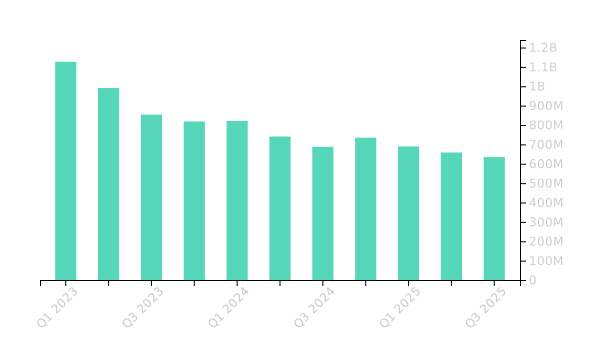
$AMN had revenues of $748.2M in Q4 2025. This is an increase of 1.84% from the same period in the prior year.
You can track AMN financials on Quiver Quantitative's AMN stock page.
$AMN Hedge Fund Activity
We have seen 108 institutional investors add shares of $AMN stock to their portfolio, and 175 decrease their positions in their most recent quarter.
Here are some of the largest recent moves:
- BOSTON PARTNERS added 1,021,672 shares (+7583.1%) to their portfolio in Q4 2025, for an estimated $16,101,550
- WOODLINE PARTNERS LP removed 990,514 shares (-100.0%) from their portfolio in Q4 2025, for an estimated $15,610,500
- VANGUARD GROUP INC removed 753,433 shares (-17.2%) from their portfolio in Q4 2025, for an estimated $11,874,104
- MILLENNIUM MANAGEMENT LLC added 718,048 shares (+55.8%) to their portfolio in Q4 2025, for an estimated $11,316,436
- ALGERT GLOBAL LLC removed 512,471 shares (-88.9%) from their portfolio in Q4 2025, for an estimated $8,076,542
- TRIBUTARY CAPITAL MANAGEMENT, LLC removed 451,381 shares (-54.3%) from their portfolio in Q4 2025, for an estimated $7,113,764
- NEW SOUTH CAPITAL MANAGEMENT INC removed 411,986 shares (-76.2%) from their portfolio in Q4 2025, for an estimated $6,492,899
To track hedge funds' stock portfolios, check out Quiver Quantitative's institutional holdings dashboard.
$AMN Analyst Ratings
Wall Street analysts have issued reports on $AMN in the last several months. We have seen 3 firms issue buy ratings on the stock, and 1 firms issue sell ratings.
Here are some recent analyst ratings:
- BMO Capital issued a "Outperform" rating on 01/15/2026
- Citizens issued a "Market Outperform" rating on 11/07/2025
- Truist Securities issued a "Buy" rating on 10/13/2025
- B of A Securities issued a "Underperform" rating on 09/10/2025
To track analyst ratings and price targets for $AMN, check out Quiver Quantitative's $AMN forecast page.
$AMN Price Targets
Multiple analysts have issued price targets for $AMN recently. We have seen 6 analysts offer price targets for $AMN in the last 6 months, with a median target of $23.5.
Here are some recent targets:
- Constantine Davides from Citizens set a target price of $24.0 on 02/23/2026
- Mark Marcon from Baird set a target price of $23.0 on 02/20/2026
- A.J. Rice from UBS set a target price of $19.5 on 02/20/2026
- Jeffrey Silber from BMO Capital set a target price of $25.0 on 01/15/2026
- Tobey Sommer from Truist Securities set a target price of $24.0 on 10/13/2025
- Kevin Fischbeck from B of A Securities set a target price of $18.0 on 09/10/2025
Full Release
DALLAS, Feb. 26, 2026 (GLOBE NEWSWIRE) -- While nearly three-quarters of healthcare executives believe their own organizations will be as strong or stronger in 2026, more than half expect the healthcare industry overall to face a worse year ahead, according to a new survey of healthcare executives. The findings highlight a widening confidence gap alongside a rapid rise in demand for AI-savvy leaders and persistent weaknesses in succession planning and clinician engagement.
Conducted by B.E. Smith, a leading provider of healthcare executive search services and a division of AMN Healthcare, the 2026 Healthcare Leadership Trends survey captures perspectives from healthcare leaders on the forces shaping recruitment, retention, engagement, leadership development, and the financial and operational context influencing decision-making in the year ahead.
“Healthcare leaders are navigating a complex mix of financial pressure, workforce realities, and rising expectations for innovation,” said Tessa Misiaszek, president of leadership solutions at AMN Healthcare. “This year’s findings reinforce that the winners in 2026 will be organizations that invest in strong, adaptable leadership, especially leaders who can implement and translate AI and technology advancements into meaningful improvements to access, quality, and operational performance.”
The 2026 findings reflect a nuanced view of the path forward: leaders are relatively steady in their outlook for their own organizations, yet significantly more concerned about the broader industry environment. At the same time, the report highlights accelerating momentum for artificial intelligence (AI) leadership and capability-building alongside ongoing headwinds in leadership recruiting, clinician engagement, and succession readiness.
Key Findings
- A widening confidence gap is emerging. Almost three-quarters of respondents expect their organization’s health to be better or the same as 2025, while 52% forecast a worse year for the industry overall.
- AI leadership is surging in importance. AI roles moved to the top of leadership priorities for 2026, with leaders citing the need for developing a clear AI strategy ( 63% ), engaging clinicians and staff to grow adoption ( 48% ), and investing in data infrastructure ( 41% ).
- Retention risk shows signs of cooling, but mobility remains. Among leaders considering leaving, 35% would like to do so within one year. At the same time, the report notes signals of reduced urgency to move compared to prior years.
- Career advancement remains a friction point. Only 21% of respondents consider themselves to be on promotion track, while 26% feel they must leave their employer to advance often citing limited internal opportunities.
- Leadership recruiting is still difficult and organizations are expanding tactics. Four in ten respondents regard attracting quality leadership candidates as extremely or very challenging.
- Clinician engagement continues to lag. Leadership teams are perceived as highly engaged compared to physicians and nursing staff, continuing a multi-year pattern and highlighting ongoing workforce experience challenges.
-
Succession planning remains underdeveloped.
Fewer than half of responding organizations maintain formal succession planning for any leadership level, including the top echelon.
B.E. Smith’s Healthcare Leadership Trends survey is conducted annually to assess the plans, perspectives and challenges facing healthcare leaders in the coming year. The 2026 survey is based on 703 responses from healthcare executives nationwide representing a range of leadership levels, organizational types, and hospital sizes. To learn more, download the report or join the upcoming Becker’s Hospital Review webinar, “ The Future of Healthcare Leadership: Risks, Realities, and Readiness for 2026 ,” based on the survey findings.
About B.E. Smith and AMN Healthcare
B.E. Smith is a leading provider of interim healthcare executive, healthcare executive, and academic search services and is a division of AMN Healthcare.
AMN Healthcare is the leader and innovator in total talent solutions for healthcare organizations across the United States. Through a steadfast partnership approach, we solve the most pressing workforce challenges to enable better clinical outcomes and access to care. We provide a comprehensive network of quality healthcare professionals and deliver a fully integrated and customizable suite of workforce technologies.
|
Media Contact
Corporate Communications AMN Healthcare [email protected] |
Investor Contact
Randle Reece Senior Director, Investor Relations & Strategy AMN Healthcare (866) 861-3229 [email protected] |